
KEO News Wire
Rugby’s Greatest Rivalry series favours hosts South Africa
The secret to the Springboks success extends beyond coach Rassie Erasmus’s first-choice match 23
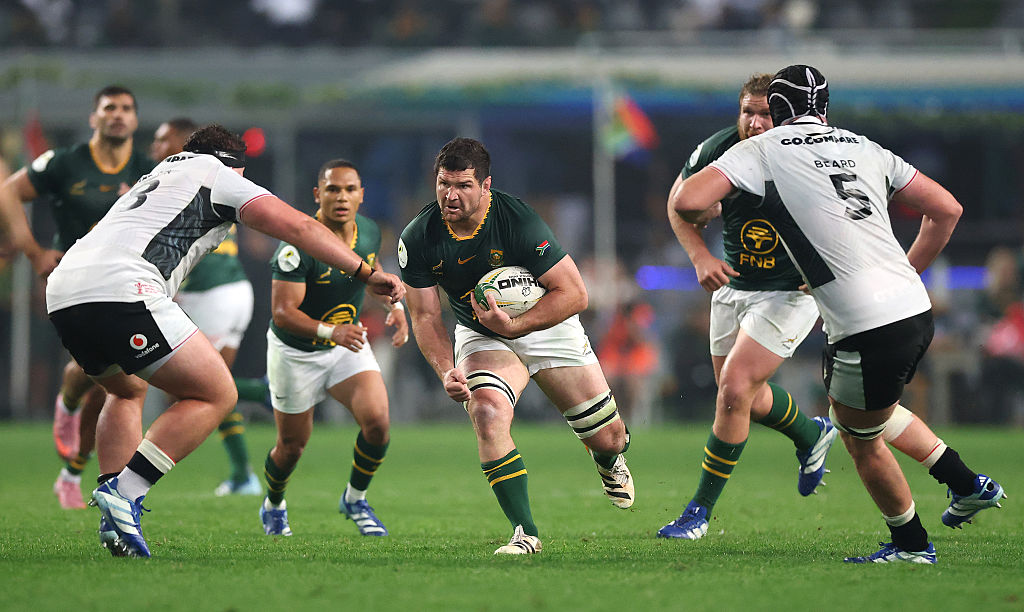
Rugby’s Greatest Rivalry Series between South Africa and New Zealand leans towards the Springboks because of player depth.
If you picked the strongest run on XV and match 23 there is not much to choose between the sport’s No 1 and No 2 nations.
But if one assesses the recent Nations Championship and South Africa’s reserve strength, the odds are weighted against New Zealand repeating the heroics of the 1996 All Blacks, who won a series in South Africa for the first time.
It remains the All Blacks only tour series win in South Africa.
The two nations have met 11o times and combined for seven, from a possible 10, World Cup titles.
The secret to the Boks success
In the Sunday Times I wrote that ambition within South African rugby to be the sport’s leaders is grounded in realism, work ethic and an understanding that no matter how bright the flame the coals constantly need stoking.
Springboks coach Rassie Erasmus has refused to allow the success of winning back-to-back World Cups and successive Rugby Championship titles to determine the immediate challenge of beating the All Blacks in Rugby’s Greatest Rivalry Series.
It was a similar mindset and attitude when he used 43 players to win the first three Nations Championship matches in July against England, Scotland and Wales.
Player time management is such that 27 of the 43 played less than 80 minutes out of 240 minutes across the three Tests.
Erasmus, post the England victory, hailed the continued growth within the squad, but was measured in his praise, both as a team collective and when talking individuals.
It was a July post-match trend for the most successful coach in Springboks history.
“The match provided an opportunity to assess the depth of the squad, with several less experienced players stepping up. While not brilliant, these players performed adequately at Test level,” said Erasmus after the 45-21 Nations Championship win against England.
Springboks captain Siya Kolisi and the most capped Springbok Eben Etzebeth were late withdrawals against England. Erasmus replaced the iconic duo’s 244 combined Test appearances with two players whose combined Test time totaled 37 minutes.
Stormers flanker Paul de Villiers started on debut and Bulls loose-forward Cameron Hanekom started his first Test after making his debut against Wales in 2024.
Both were substituted at half-time.
Erasmus’s philosophy has always emphasised that training can’t simulate the pressures of Test rugby.
Answers don’t come in training, he said.
“You get answers in a Test, when your own crowd goes silent and the opposition is getting momentum, when the ball is slippery and the mistakes come, when the tackle is hard and the immediate recovery tests a player’s mentality as much as his physicality.
“We wanted to ask questions of players and we got those answers,” he said. “Some handled the Test-match experience better than others.”
The Nations Championship and the pending All Blacks series is about adding depth for a Springboks squad in search of an unprecedented third successive World Cup title in Australia in 2027.
For Erasmus it is about maintaining a winning habit, about learning while winning and about expanding the quality of the squad, in which there are three world-class players in each position.
“We had 13 players with less than 10 caps against Scotland and four with less than 20 caps. We beat a very good team that had scored 50 points against France in the Six Nations and 47 points against the Pumas in Argentina. It is pleasing to learn and get the win when introducing so much change,” said Erasmus, who is as focused on the 2031 World Cup preparation, as he is with the more immediate challenge of 2027.
Erasmus picked 10 of the Junior Springboks to play the Zimbabwe Sables and included two – lock Riley Norton and No 10 Vusi Moyo – in the Springboks match 23 against the Barbarians.
Norton missed out on the Nations Championship because of injury, but Moyo made his Test debut as a 20 year-old against Wales.
The remaining Junior Boks were inspirational in winning the under 20 World Rugby Championship a week ago by beating France 16-5 in the final.
The introduction of Dave Wessels as SA Rugby’s High Performance Manager, the appointment of Kevin Foote as SA Under-20 coach, Philip Snyman as Blitzboks coach, and Swys de Bruin’s leadership of the Women Springboks has allowed Erasmus to focus on the Springboks.
Erasmus, privately and publicly, has applauded the efforts of Wessels and merits of the structural change, which means all the national squads are aligned in philosophy, ambition and accountability.
The Springboks are back-to-back World Cup winners, the under-20s are back to back World Championship winners, the Blitzboks are back to back world champions and the Women Boks made their first ever World Cup quarter-final.
“Footey and I coach Super Rugby in Australia for many years,” said the South African born and raised Wessels. “He is an excellent technical coach and he is perfect for the Junior Bok environment and leading young men. The women’s programme needed someone with Swys’s experience. The energy around women’s rugby is fantastic and it is the next frontier for us performance-wise.”
Wessels is there to make sure the Erasmus player blueprint is followed, from top down to the national under 18s.
“Rassie put brilliant systems in place when he was Director of Rugby. We put all our resources into making sure we find the best players, and that those players are well-coached in a way that sets them up to become successful Springboks.”
-
 Champions Cup5 days ago
Investec Champions Cup: Roadtrip is Bulls & Stormers big test
-
 Champions Cup5 days ago
Investec Champions Cup enjoys record-breaking start to season
-
 Champions Cup1 week ago
Investec Champions Cup: South Africans who rocked in Round 1
-
Champions Cup2 weeks ago
Investec Champions Cup is SA rugby’s next frontier
-
 Champions Cup1 week ago
Bordeaux and Gloucester show South Africa what the Investec Champions Cup can be
-
 KEO News Wire5 hours ago
Stormers No 10 Yaqeen Ahmed set for Boks call-up
-
 Champions Cup1 week ago
Investec Champions Cup: Bulls & Stormers make their mark as Lions play through grief
-
 KEO News Wire2 weeks ago
All Blacks hammering of Wallabies give Springboks series win perspective