
Champions Cup
The Leinster Narrative on Nienaber Is Wrong
The narrative around Jacques Nienaber at Leinster doesn’t match reality. Results, context and history tell a very different story.
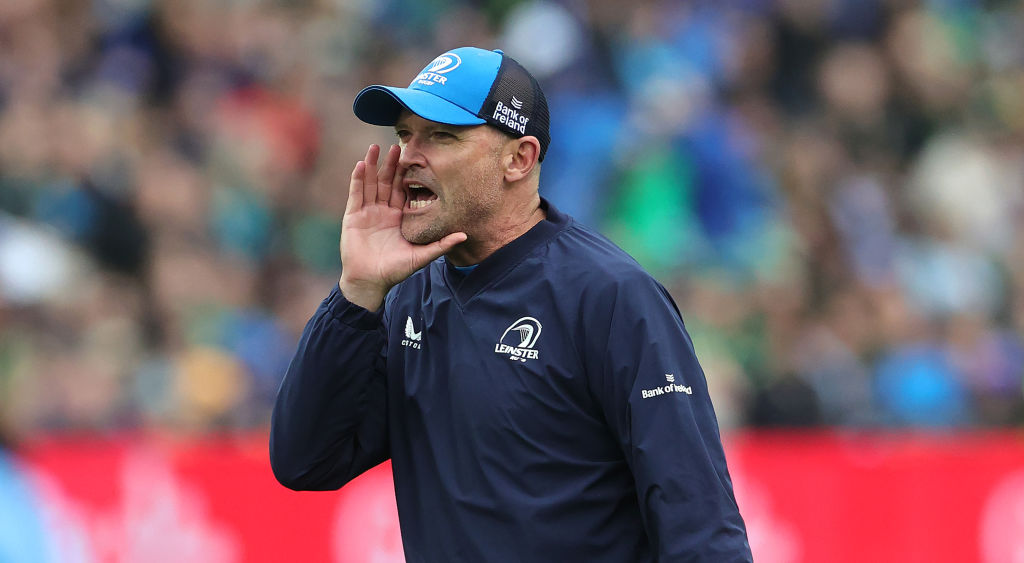
There is a curious narrative doing the rounds in Irish rugby circles, and it says far more about perception than performance. It is especially prevalent on Investec Champions Cup weekends because the Leinster narrative on Jacques Nienaber is wrong.
When Leinster lose, Nienaber is the problem. When Leinster win, Leo Cullen is the architect.
It is lazy, a convenient narrative and fundamentally dishonest.
Nienaber is a coach at Leinster and Cullen is the Director of Rugby/Head Coach.
Nienaber, the 2023 Springboks World Cup-winning coach, did not arrive in Dublin to universal applause. He arrived with baggage of unfamiliarity, and most certainly not on the back of any failure.
Nienaber is South African, proudly so, and the architect of the Springboks’ 2021 series win against the British & Irish Lions and the 2023 World Cup final win against the All Blacks.
Nienaber is defensive-minded, and he followed the aura of a golden Leinster generation that had long made winning look routine, more so in the old Pro Rugby League than in the flagship European Championship.
In Irish media and ex-player shorthand, he became the outsider walking into a system that “should” keep winning.
But systems age, cycles end and dynasties fade.
The Leinster that Nienaber inherited is not the Leinster that was formidable for a short period in Europe under Jonny Sexton. That team was driven by a once-in-a-generation No 10 general in Sexton and loaded with the heartbeat of an Irish national squad considered the best ever produced.
The Leinster, pre Nienaber’s arrival in 2024, had form, balance in age, a winning habit and unrivalled club depth in Europe. This allowed for playing two squads in different competitions, knowing that the reserve squad was still better than the majority of 1st team choices in Pro Rugby.
This did not immediately translate to titles in the newly formed United Rugby Championship, which included South Africa’s four premier clubs. Leinster lost in the semi-finals in the first three seasons before winning a home final against the Bulls last season.
The depth in 2026 is not what it was pre-Nienaber’s arrival; neither is the players’ swagger.
The certainty has also softened.
Yet this context is routinely ignored when Nienaber’s role is second guessed, more so by ex-players than those in the current squad.
Instead, the narrative is simplified and presented as Cullen being the calm overseer when things go right and Nienaber the disruptor when they do not.
It is a convenient narrative because the reality is a different story.
Nienaber’s first full season in the United Rugby Championship, in 2024/25, delivered a first ever competition title.
He tightened a defensive system that, for all Leinster’s attacking brilliance, had shown cracks in knockout rugby. He brought edge and instilled confrontation.
He brought a Springbok steel to a team that, at times, had been accused of playing pretty rugby without the brutality required to close out the biggest matches.
And yet, even in success, the credit felt diluted.
Contrast that with the narrative around Johann van Graan at Bath.
Van Graan inherited a broken club – his words, not mine – and has been rightly celebrated for dragging it back into relevance. Every Bath win is framed as a triumph of coaching. Every step forward is his rebuild of his culture and his system.
Equally Franco Smith at Glasgow.
The former Springboks utility back and Italian national coach has transformed Glasgow, winning a URC title away from home when they beat the Bulls at Loftus in Pretoria, and turning Glasgow into one of the most respected clubs in Europe.
Smith has been praised, and rightly so. His fingerprints are everywhere in style and identity.
But in Dublin, the same generosity is not extended.
Why?
Because, somewhere between Leinster being the extra at a wedding for two decades, they got to be the groom.
Short-term success – four Investec Champions Cup titles in 30 attempts – is told as if it were 30 title wins, which has created the illusion that this is a club that has never experienced failed campaigns.
For 26 of the last 30 seasons, Leinster were not the Kings of Europe and in four URC seasons, they have worn the crown just once.
Nienaber is the not the reason for Leinster’s indifference when they don’t field 23 internationals in their match 23.
The former Boks coach has never been a passenger in Leinster’s successes since his arrival in 2024, nor is he the sole author of their failures.
Nienaber’s contract with Leinster ends in June 2027 and he has yet to confirm what his future holds.
I do hope it is in South Africa.
Courtesy of Keo Uncut on Times Live Sport


-
 KEO News Wire2 weeks ago
Rassie’s Perth gamble comes with a loaded bench
-
 KEO News Wire2 weeks ago
Wallabies expose the gulf between Boks best and the rest
-

 KEO News Wire2 weeks ago
World media: Wallabies beat the Boks – they did not steal it
-
 KEO News Wire1 week ago
Springbok gains: The Boks who advanced in 2026
-
 KEO News Wire2 weeks ago
SA media: Springboks comeback does not hide Perth beating
-

 KEO News Wire5 days ago
Eben Etzebeth ignites spirited & stunning Sharks in URC
-
 KEO News Wire2 weeks ago
Four from four: South Africa owns URC opening round
-
 KEO News Wire1 week ago
SA’s Next Gen kids are winning in the United Rugby Championship