
KEO News Wire
Give the world champion Springboks a break
South African rugby’s finest players cannot continue to play the game and peak all-year round.
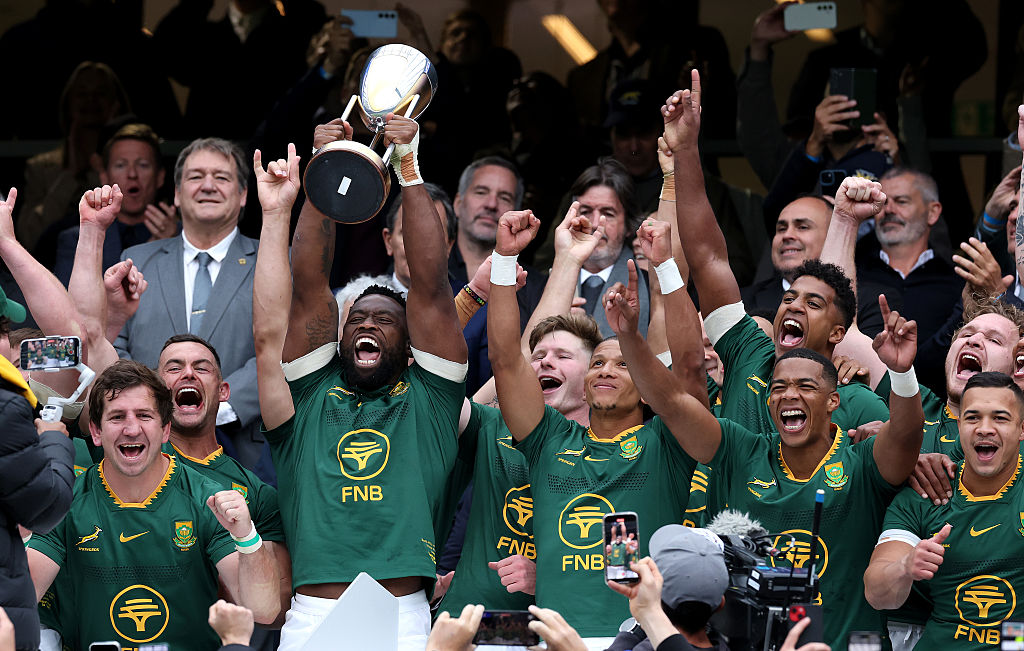
The world champion Springboks are the No 1 team in the world. Their players are also No 1 in being overworked. They need a break.
World Champion Springboks
Give the Springboks and South African rugby the same respect and reverence that is given to accidental head clashes.
World Rugby is obsessed with anything that may involve a player’s head. It is their way of guarding against future law suits.
But what’s inside a player’s head is as secondary to a player’s lower back and knees, where most of the serious injuries happen.
Concussions and head clashes have become vogue in rugby ever since legal law suits started happening, and the ridiculous and inconsistency in application is always excused on the basis of player welfare, but if player welfare was such a priority then Springboks players would not be asked to play 11 out of a possible 12 months, week in and week out.
World Rugby consistently fails itself as an organisation that purportedly prioritises player welfare.
If player welfare was the greatest consideration, then a global season would have been a reality a long time ago.
As it is, traditional power plays between the elected officials of the northern and Southern Hemisphere still control the professional game.
One day, hopefully sooner rather than later, the madness of how long the elected suites held onto controlling the on-field professionals will be mocked and not accepted as law.
I have long been an advocate of a professional breakaway from the game, but nothing seems capable of breaking the old boys club and no player body seems able to stand together globally and down tools.
While this continues, players will be treated as liabilities and not assets.
Individuals within World Rugby want change for the players, despite the collective suffocation of disregarding players.
The lone voice in fighting for players around the world is SA Rugby President Mark Alexander.
He has been the leading advocate of a global season, in which global welfare of players is the essence and not just protecting his home South African patch.
But he and a minority fight a losing battle in the boardrooms of those elected to govern because the game is not governed by professionals.
South Africa’s best players, those who are in the Springboks squad, can’t continue to last, let alone perform, when playing 11 months of 12, without an off-season.
When New Zealand and Australia’s best finish the end of year tour at the end of November, they break and are gradually introduced into Super Rugby Pacific, which starts in February.
When South Africa’s Springboks finished last year at the end of November, those based in South Africa and playing for European and English and Celtic clubs, were playing for their clubs in the Investec Champions Cup week later. A fortnight later, on the eve of Christmas, the same individuals were playing in the United Rugby Championship.
A week later, into the first week of the new year, the same players were playing in the Investec Champions Cup.
And so it has continued and will until the 20th June when the URC final is determined.
A fortnight later the players will be involved in the opening round of the Nations Championship and when the northern hemisphere’s best rest in August, South Africa’s best will continue to go in the Rugby Championship against Australia, New Zealand and Argentina.
It is madness.
It makes the success of the Springboks, back to back world champions and Rugby Championship winners, even more remarkable.
SA Rugby Magazine reported on World Rugby’s acknowledgement of this madness.
But still there is no solution.
World Rugby CEO Alan Gilpin has acknowledged growing concerns around the workload of Springbok players.
Gilpin conceded that the sport has yet to find a workable global solution.
“What we haven’t been able to do in the men’s global calendar discussion for as long as I’ve been involved in the game, which is more than 20 years, is get to full alignment where the international windows are aligned across the globe,” he said on the Rugby Unity podcast.
“It’s challenging because there are conditions in different parts of the world. There are different professional domestic competitions being played and they’ve built their economic models around the calendar as it is.
“Moving one piece requires compromise in other areas and that’s the challenging debate.”
SA RUGBY CEO: Global season needs compromise
However, Gilpin stressed there is increasing agreement around the need for change, particularly from a player welfare perspective.
“Players are at the heart of that. If you’re a South African player playing your domestic rugby in Europe and playing for the Springboks in their international competitions, including the Rugby Championship, that’s an 11-month season and it’s not sustainable at the level the game’s being played.”
Gilpin added that while progress has been made, a global calendar remains some way off.
“We’ve got to try and find those solutions, so there’s really good recognition of that. And then of course, what does the fan want? The fan wants more alignment and more coherent global calendar.
“There’s been good discussions but more work to do. We want to play a role as a facilitator and a driving force from a World Rugby perspective in those discussions as I think we have over a number of years and just continue to bring people together.
“There’s a commitment to continue looking at that which I think is really powerful.”
But it is not powerful. It is pathetic because the commitment is not to change, but rather to continue looking.
One day, who knows when, players may realise they are the assets and they have the control, which if they ever realised it, would be powerful.




-
 KEO News Wire4 days ago
Rassie’s Perth gamble comes with a loaded bench
-
 KEO News Wire1 day ago
Wallabies expose the gulf between Boks best and the rest
-

 KEO News Wire2 weeks ago
How NZ Media rated Siya’s Super Springboks
-

 KEO News Wire2 weeks ago
All Blacks unlock the Springboks R84m American payday
-
 KEO News Wire2 weeks ago
Perth puts the Springboks 2027 World Cup path on trial
-

 KEO News Wire1 day ago
World media: Wallabies beat the Boks – they did not steal it
-

 KEO News Wire2 weeks ago
Boks by 10 – and so it proved over four fabulous Tests
-

 KEO News Wire1 week ago
Sacha Feinberg-Mngomezulu is a fabulous rugby player