
KEO News Wire
Rassie’s Springboks defy the stats and dominate the scoreboard
The Springboks set piece creates scoring opportunities that conventional attacking statistics don’t capture.
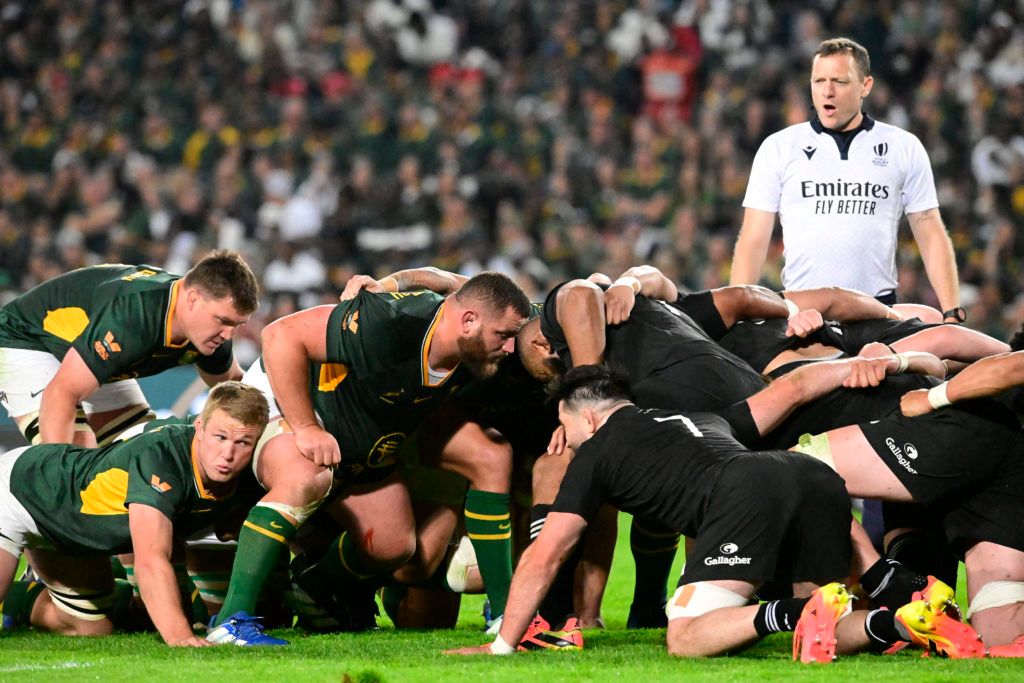
The most revealing feature of the 2026 Nations Championship statistics is that Rassie Erasmus’s Springboks are the competition’s most prolific scoring team, despite not being among the leading teams in the volume of rugby played.
Springboks
The Springboks have scored 196 points and 29 tries in four Tests. They average 49 points and 7.25 tries per match. Yet they do not feature among the leading five teams for metres gained, carries or offloads.
Their latest effort was a 66-7 humiliation of Italy in Turin.
It is an insight into how Rassie Erasmus’s Springboks play.
The Boks are not necessarily trying to carry the ball more often, make the most metres or complete the most passes. They are trying to turn possession, territory and pressure into points more effectively than their opponents.
And they do!
What the statistics tell us
| Metric | Leading team | South Africa |
|---|---|---|
| Points | South Africa – 196 | 1st |
| Tries | South Africa – 29 | 1st |
| Tackles | Italy – 779 | Outside top 5 |
| Metres gained | France – 2,282 | Outside top 5 |
| Carries | New Zealand – 739 | Outside top 5 |
| Offloads | Fiji – 60 | Outside top 5 |
Five reasons this is happening
1. The Springboks are scoring without needing sustained possession.
A team can make 15 carries across multiple phases and not score. The Boks can win a scrum penalty, kick into the opposition 22 and score from a driving maul or a short sequence of carries.
The statistical return is enormous, even though the number of carries and metres gained may be modest.
2. Their set piece creates scoring opportunities that conventional attacking statistics don’t adequately capture.
Scrum dominance, lineout accuracy, mauling and penalties won are critical to South Africa’s attacking identity. These create territorial and scoring opportunities without necessarily producing big numbers for running metres or offloads.
3. They prioritise territory over possession.
The Boks are comfortable kicking the ball away when it puts the opposition under pressure. An effective territorial kicking game can produce attacking opportunities through poor exits, aerial contests, turnovers and penalties.
That approach reduces the need to build attacks through repeated carries from deep inside their own half.
4. They don’t need to lead the offloading statistics.
Fiji’s 60 offloads illustrate a very different attacking philosophy. South Africa’s game is more structured around winning collisions, securing possession and identifying the right moment to release their backs.
Offloading is an attacking tool, not an objective in itself. The quality and timing of an offload matter more than the number attempted.
5. Their scoring reflects the value of their opportunities, not simply the quantity of their activity.
This is the most important distinction. Carry totals measure activity. Metres gained measure ground covered. Neither directly measures how effectively a team converts attacking opportunities into tries.
The Boks’ scoring output is consistent with an exceptionally effective conversion of pressure into points.
The most telling comparison
The detailed rankings from the first three rounds offer an even clearer illustration:
-
New Zealand averaged 199.7 carries per match; South Africa just 116.3.
-
New Zealand averaged 589 running metres; South Africa 430.
-
Fiji averaged 16.7 offloads; South Africa just 4.7.
The Springboks ranked eighth for carries and offloads, and sixth for metres gained at that stage.
What this says about Erasmus’s rugby philosophy
The Springboks in the Nations Championship are demonstrating that attacking effectiveness and attacking volume are two very different things.
The most carries don’t necessarily win you a match. The most running metres don’t guarantee tries. The most offloads don’t automatically translate into scoreboard dominance.
The Boks success comes from combining traditional strengths in the set piece, physical confrontation, tactical kicking and territorial pressure with an increasingly dangerous attacking game.
And there is another significant number: the Boks have conceded only 56 points and eight tries in four matches, while scoring 196 points and 29 tries. Their points differential is an extraordinary +140.
That combination of scoring power and defensive effectiveness is more revealing than any isolated attacking or defensive statistic.





-

 KEO News Wire2 weeks ago
Stormers No 10 Yaqeen Ahmed set for Boks call-up
-
 KEO News Wire2 weeks ago
JP Pietersen gives Sharks belief and bite
-

 KEO News Wire1 week ago
From schoolboys to Springboks in a year: Ahmed and Muller
-

 KEO News Wire1 week ago
Why Rassie Erasmus is fast-tracking the next generation of Springboks
-

 KEO News Wire4 days ago
Bring Nienaber home for World Cup glory
-

 KEO News Wire4 days ago
Springboks return home to boost SA rugby
-

 KEO News Wire6 days ago
Rassie sends a warning with powerful Bok selection
-

 KEO News Wire2 days ago
Sacha Feinberg-Mngomezulu sizzles for Boks in Turin