
KEO News Wire
Wallabies expose the gulf between Boks best and the rest
Rassie Erasmus got his selections, approach and substitutions wrong in the Boks 42-38 defeat against Australia in Perth.
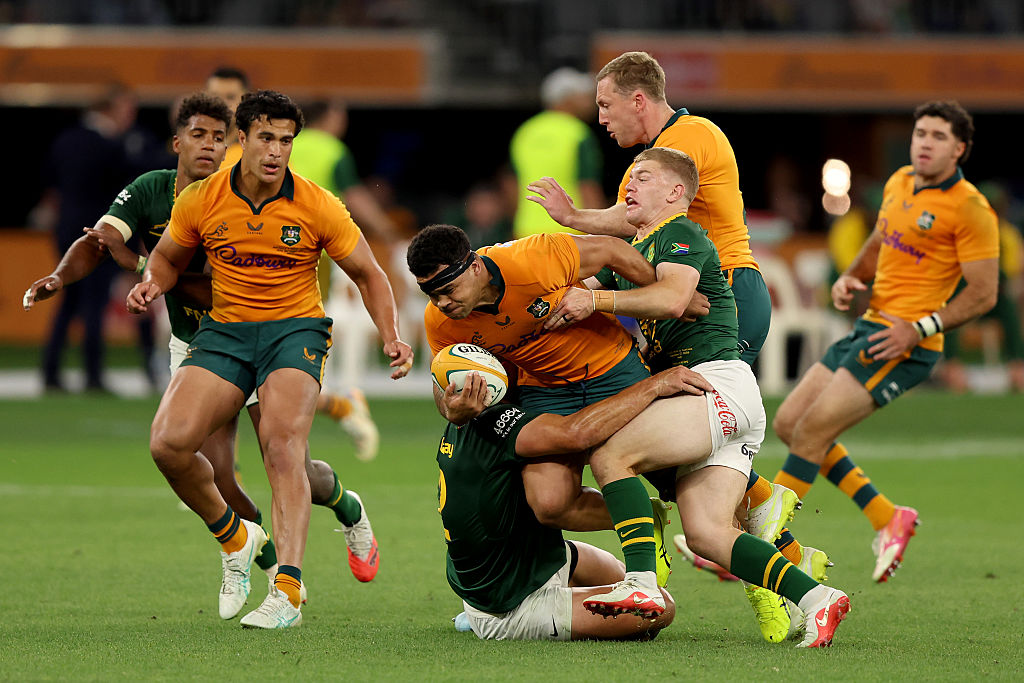
Rassie Erasmus gambled on an alternative Springboks XV in Perth, waited too long to unleash his heavyweight bench and allowed an outstanding Wallabies team to expose the difference between Boks depth and Boks World Cup-winning excellence.
The 42-38 defeat in Perth means that Rassie Erasmus’s back-to-back World Cup champions have won just three from eight Tests against the Wallabies in Australia between 2018 and 2026.
In this time the Boks have won the 2019 and 2023 World Cups, the 2021 British & Irish Lions series and the 2026 Rugby’s Greatest Rivalry series against the All Blacks. But the Wallabies in Australia remains an Achilles Heel, and the 2027 World Cup is being hosted by the Wallabies in Australia.
The Boks will play one of Australia or the All Blacks in the 2027 quarter-final, given the draw.
Both the Wallabies and All Blacks have produced one-off wins against the Boks in the last year, with the Wallabies and All Blacks winning at Ellis Park and the Wallabies adding another win on Sunday in Perth.
While Erasmus and his co-pilot between 2018 and 2023 Jacques Nienaber have averaged a 70-plus percentage win in a coaching Test career tenure that started with Erasmus as head coach and Nienaber as assistant, then Nienaber as head coach between 2020 and 2023 and Erasmus as National Director of Rugby, and then Erasmus back to head coach since 2024, the record in Australia, against the Wallabies, is 37.5 percent.
The Springboks enjoyed back-to-back wins in Brisbane and Perth in 2024, but outside of that Rugby Championship double, it has been one from six in all visits dating back to 2018 when the Boks lost 23-18 in Brisbane.
Erasmus, for Sunday’s defeat, made 13 changes to his starting XV from that which finished off the All Blacks 43-28 in Baltimore, USA a fortnight ago to claim the Rugby’s Greatest Rivalry Series 3-1, and the disconnect was obvious in an opening 45 minute period dominated by the Wallabies.
The hosts, who won the Test 42-38, after leading 24-17 at halftime, had all the cohesion and comfort of having played seven successive Tests as a unit preceding this Test match.
The Boks had not played in this formation and the core of the squad had not played for the past six weeks.
This is not to offer anything but applause to the Wallabies for a game plan, an approach, execution and enough points by 65 minutes to secure a victory that somehow was threatened in a chaotic final few minutes.
The Wallabies led 42-17 with 15 minutes to play before the Boks bench-player impact kicked into overdrive, the set piece became a reality and Sacha Feinberg-Mngomezulu started asking questions at flyhalf. The result was three converted tries with 20 seconds to play and one score in it.
The Boks were not good enough to mount an attack from the final kick-off and got penalised for obstruction in trying to run it out from their 22.
Erasmus, as Boks coach, has got so much right in winning everything there is to win in international rugby but on Sunday in Perth he got everything wrong, from selection, to game plan approach and, crucially, to his substitutions.
Erasmus picked a powerhouse eight-strong replacement bench that should have been introduced en-masse in the 35th minute, with the teams locked 17-all and the momentum clearly favouring Australia.
Instead, he held out, Australia scored just before halftime, and added more points early in the second half.
When he introduced the bench, all eight in one go in the 47th minute, a gold tide had swept aside the Boks and the score soared to 42-17 just after an hour.
By the time the replacement players had settled and started to assert themselves, there was just 15 minutes to play and the Boks were 25 points behind.
The Boks effort in the final 15 was remarkable. The Boks scored three tries, reduced the Wallabies to 11 players through repeated professional infringements and finally got to use their scrum. There simply was not enough time to conjure up a win that would have been hailed a miracle.
But a miracle win would have masked that there is a distinct difference between the first choice Springboks starting XV and the second choice Springboks starting XV.
Les Kiss’s Australia were outstanding in the first 65 minutes. They controlled the tempo, sucker punched the Boks to adapt to their free-flowing Super Rugby-style of play and, as they did at Ellis Park a year ago, gave the Boks a lesson in back play, at the breakdown and in the aerial battle.
What is it about these Aussies that they so easily get into the minds of the Boks and seduce them into playing a game they are ill-equipped to play?
When it comes to back play, quick hands and understanding the width of the field and depth of attack, there are none better than the Wallabies and All Blacks.
They are the backs equal of the Boks first-choice set piece.
I use the word first-choice to highlight that there is a Boks first choice and there is a Boks preferred/A team. Called it whatever you want, but there is an A and B team. The B team started in Perth. If not the B team then those 13 players who did not start in Perth from Baltimore would have started in Perth.
There is no comparison between the Boks front row that started and that which came off the bench. As a combination, there is no comparison to the midfield duo in Perth and Damian de Allende and Jesse Kriel in Baltimore. Kurt-Lee Arendse and Cheslin Kolbe’s pedigree on the wing speaks for itself and Damian Willemse is in a class of his own as the first choice Springboks fullback.
(Sacha) Feinberg-Mngomezulu is comfortably the Boks first choice No 10 and Morne van der Berg and Cobus Reinach are the top two No 9s.
Individually, there is no equal to Siya Kolisi as a player and captain, Pieter-Steph du Toit is a cut above any other No 7 flank and Jasper Wiese is the best No 8 in South Africa.
For 65 minutes those players were either in South Africa resting, on tour with their URC teams, in Japan with their club teams, in the stands or 18 minutes into a losing cause.
This is the context and perspective to Sunday’s afternoon defeat.
As good as the Wallabies were in those first 65 minutes, they were up against the alternative Boks XV, 13 of whom were not considered the best to win the series against the All Blacks.
This does not make these 13 poor players. To the contrary, they are all quality players but they are currently second or third in the pecking order, and they have not played rugby for six weeks.
Fair play to the Wallabies for exposing the difference in quality between the preferred and alternative Boks starting XV and for punishing the disconnect in a line-up that may have trained together but had never played together.
The Wallabies, in the first 65 minutes, made just 54 tackles. In the last 15 minutes they were forced to make 56 tackles. The Wallabies, in the first 65 minutes, enjoyed 70 percent possesion and field position. In the final 10 mintues, this was down to 26 percent respectively.
The final result, if social media is the guide, has shocked many South Africans.
It should not, when the context is who started in Baltimore and who started in Perth. Combine that with the continued struggles of the Springboks when playing in Australia and the one-score win for Australia was consistent with recent history, if not current world ranking.
Rassie responds to the Boks defeat
Springboks v Wallabies: 2018–2026
Scores below are presented from the Springboks’ perspective.
| No. | Date | Venue | Country | Score | Result |
|---|---|---|---|---|---|
| 86 | 8 September 2018 | Lang Park, Brisbane | Australia | 18–23 | Lost |
| 87 | 29 September 2018 | Nelson Mandela Bay Stadium, Gqeberha | South Africa | 23–12 | Won |
| 88 | 20 July 2019 | Ellis Park, Johannesburg | South Africa | 35–17 | Won |
| 89 | 11 September 2021 | Robina Stadium, Gold Coast | Australia | 26–28 | Lost |
| 90 | 18 September 2021 | Lang Park, Brisbane | Australia | 17–30 | Lost |
| 91 | 27 August 2022 | Adelaide Oval, Adelaide | Australia | 17–25 | Lost |
| 92 | 3 September 2022 | Sydney Football Stadium, Sydney | Australia | 24–8 | Won |
| 93 | 8 July 2023 | Loftus Versfeld, Pretoria | South Africa | 43–12 | Won |
| 94 | 10 August 2024 | Lang Park, Brisbane | Australia | 33–7 | Won |
| 95 | 17 August 2024 | Perth Stadium, Perth | Australia | 30–12 | Won |
| 96 | 16 August 2025 | Ellis Park, Johannesburg | South Africa | 22–38 | Lost |
| 97 | 23 August 2025 | Cape Town Stadium, Cape Town | South Africa | 30–22 | Won |
| 98 | 27 September 2026 | Perth Stadium, Perth | Australia | 38–42 | Lost |
Results summary
| Location | Tests | Springbok wins | Springbok losses | Win percentage |
|---|---|---|---|---|
| Overall | 13 | 7 | 6 | 53.85% |
| In South Africa | 5 | 4 | 1 | 80% |
| In Australia | 8 | 3 | 5 | 37.5% |
| Neutral venues | 0 | 0 | 0 |
There were no draws.
Points summary
| Location | Springbok points | Wallaby points | Combined points | Points difference |
|---|---|---|---|---|
| Overall | 356 | 276 | 632 | Springboks +80 |
| In South Africa | 153 | 101 | 254 | Springboks +52 |
| In Australia | 203 | 175 | 378 | Springboks +28 |
Average scores
| Location | Average Springbok score | Average Wallaby score | Average combined match points |
|---|---|---|---|
| Overall | 27.38 | 21.23 | 48.62 |
| In South Africa | 30.60 | 20.20 | 50.80 |
| In Australia | 25.38 | 21.88 | 47.25 |
The striking statistic is that the Springboks have outscored Australia 203–175 in Australia since 2018, yet have won only three of the eight Tests there. Their three wins were emphatic, while Australia won five of the tighter contests.
-
 KEO News Wire3 days ago
Rassie’s Perth gamble comes with a loaded bench
-

 KEO News Wire2 weeks ago
How NZ Media rated Siya’s Super Springboks
-

 KEO News Wire2 weeks ago
All Blacks unlock the Springboks R84m American payday
-
 KEO News Wire2 weeks ago
Perth puts the Springboks 2027 World Cup path on trial
-

 KEO News Wire2 weeks ago
Boks by 10 – and so it proved over four fabulous Tests
-
 KEO News Wire2 weeks ago
Springboks are supreme in dismantling the All Blacks
-

 KEO News Wire2 weeks ago
Springboks & All Blacks justify all the pre-tour hype
-
 KEO News Wire6 days ago
Sacha Feinberg-Mngomezulu is a fabulous rugby player