
Rugby
Referees must be held accountable
World Rugby must address the lack of accountability to poor referee and match official performances.
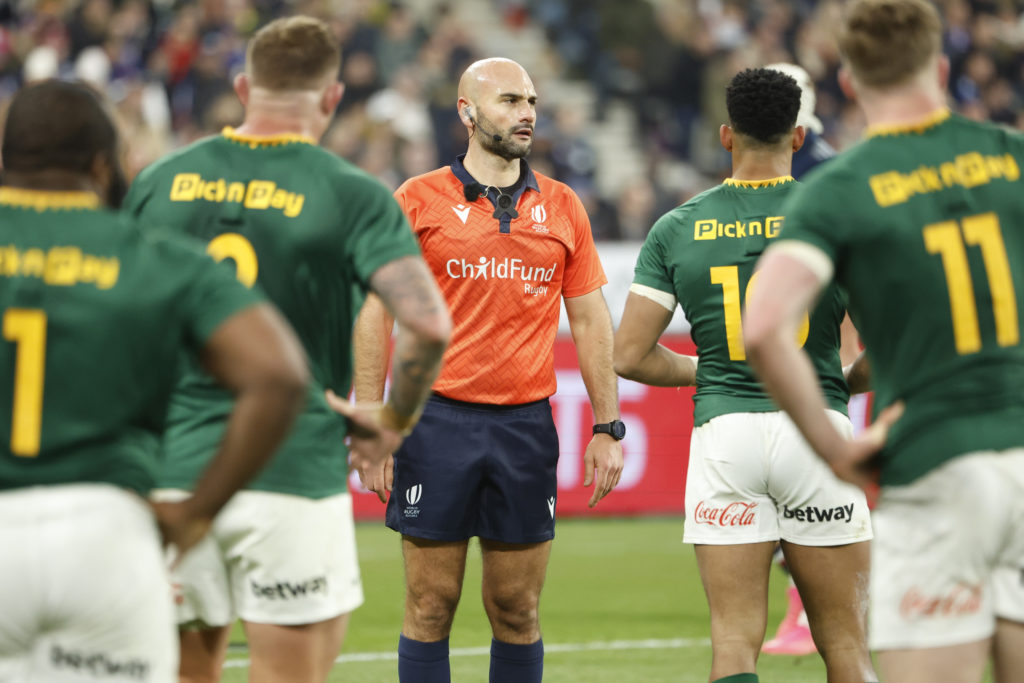
Referees are central to rugby’s credibility, but Mark Keohane and Zelim Nel believe the sport has created an officiating system that demands perfection without offering consistent accountability.
Speaking on the Keo & Zels Show, the pair examined the wider issues behind Rassie Erasmus’ latest confrontation with World Rugby, arguing that the controversy should not distract from the need for meaningful reform.
While both presenters criticised the Springbok coach’s decision to raise the possibility of match-fixing, they agreed that frustration with referees and television match officials extends far beyond South Africa.
“Referee and match-officiating accountability is non-existent in the game at every level,” Keohane said.
For Keohane, the central problem is that mistakes are repeatedly acknowledged without visible consequences or improvements.
Referees cannot escape scrutiny
Keohane pointed to controversial decisions across Test rugby, the United Rugby Championship and France’s Top 14 as evidence of a problem affecting the entire sport.
He argued that coaches are often dismissed as sore losers when they criticise referees, only to face similar criticism when they raise concerns after winning.
That leaves little room for a productive discussion about standards.
“A professional sport that brings in so much money, that has so much value, that is only going to continue to grow, can’t be taken seriously when the most important people, the match officials, aren’t held accountable or brought to task,” he said.
Keohane believes referees should face meaningful performance reviews and that persistent mistakes should influence future appointments.
He also questioned why the application of TMO protocols appears to differ between competitions.
Rugby is played globally under one set of laws, yet the interpretation and intervention of officials can appear inconsistent from one competition to another.
Has the TMO become too powerful?
Nel offered a different perspective, arguing that rugby must also accept the limitations of human decision-making.
For much of the sport’s history, matches were played without television assistance.
Referees made decisions in real time, and occasional mistakes were an unavoidable part of the game.
Nel believes the introduction of video technology has created unrealistic expectations about accuracy.
“Just like players can catch and drop a ball, a referee is going to catch and drop the ball,” he said.
“There’s a human element to everything.”
The problem, according to Nel, is the inconsistency between decisions subjected to extensive video analysis and others left entirely to the on-field referee.
He questioned whether rugby wants every incident reviewed or whether the sport should allow referees to control matches with limited intervention.
“You cannot be half pregnant in this thing,” Nel said.
Referees need clearer boundaries
Keohane favours a more restricted role for television officials.
He believes TMOs should intervene when serious foul play occurs or when an obvious mistake has been missed because the referee was unsighted.
Beyond those circumstances, he argues, the referee should be trusted to manage the match in real time.
“Rugby is played in real time and has to be officiated in real time,” Keohane said.
He warned that repeatedly slowing incidents down, examining multiple angles and revisiting previous phases can undermine the authority of the on-field referee.
Nel agreed that rugby must decide what it wants from technology.
A system promising absolute accuracy would require lengthy reviews that could make the sport increasingly difficult to watch.
But a system that retains human judgement must also accept that some calls will be wrong.
Rugby needs reform, not conspiracy theories
Both presenters believe Erasmus raised legitimate concerns about dangerous tackles and officiating standards following South Africa’s defeat to France.
Their objection was to the suggestion that missed decisions might amount to match-fixing.
Keohane argued that allegations of that nature require a different level of evidence from ordinary criticism of refereeing performance.
The broader problems facing rugby remain unresolved regardless of Erasmus’ suspension.
For referees, clearer protocols and transparent accountability could help rebuild trust.
For coaches and supporters, accepting that officials will sometimes make mistakes is equally important.
And for World Rugby, the challenge is to create a system that protects players, respects the authority of referees and delivers greater consistency without sacrificing the flow of the game.
Because until those issues are addressed, every controversial decision risks becoming another argument about the integrity of rugby itself.







-
 KEO News Wire2 weeks ago
Bring Nienaber home for World Cup glory
-

 KEO News Wire1 week ago
Rassie’s World Cup blueprint is taking shape
-

 KEO News Wire5 days ago
Rassie Erasmus got too clever in his mind games and got beaten
-
 KEO News Wire3 days ago
Rassie Erasmus going rogue has betrayed his Springboks
-

 KEO News Wire2 weeks ago
Rassie’s Springboks defy the stats and dominate the scoreboard
-

 KEO News Wire2 weeks ago
Springboks return home to boost SA rugby
-

 KEO News Wire2 weeks ago
Springboks have made Paris their fortress
-

 KEO News Wire2 weeks ago
Sacha Feinberg-Mngomezulu sizzles for Boks in Turin